A globe of where the species are
An interactive globe where the land rises with the number of mammal, bird and amphibian species living there. It can also show which mammals would live in a place without humans, and it exports as an 8 cm two-colour 3D print.
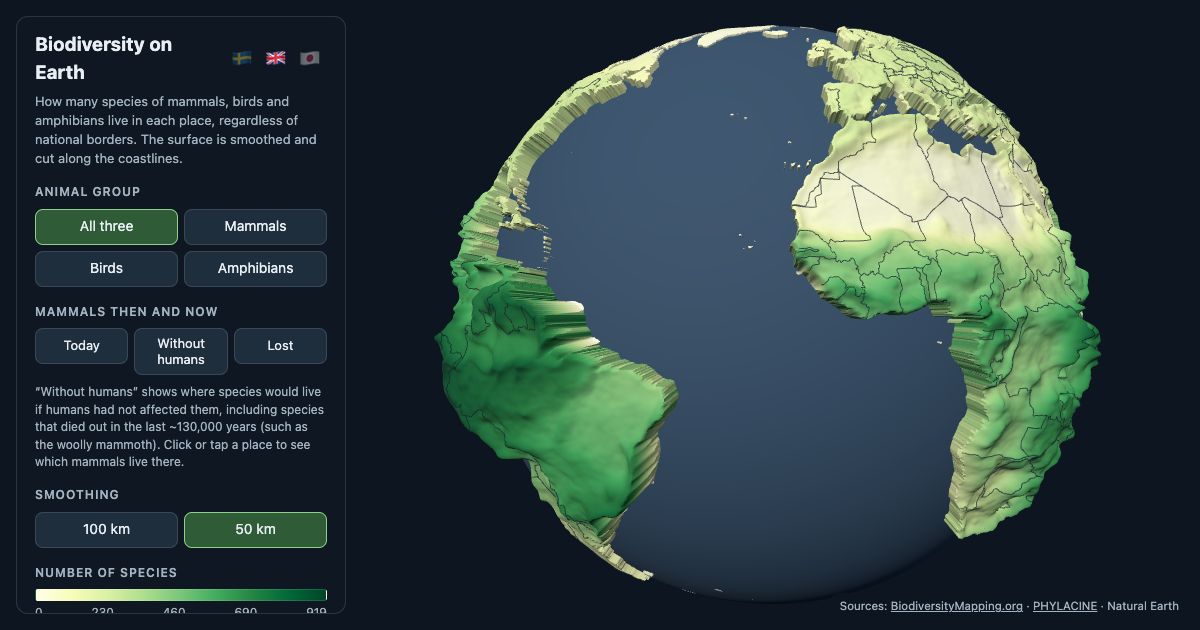
Most of my globes show climate. This one shows life: on the biodiversity globe the land rises in proportion to the number of species of mammals, birds and amphibians that live in each place, regardless of national borders.
What you see
The tallest point is in the western Amazon, near Iquitos in Peru, with about 920 species of the three groups together. Stockholm has about 190: roughly 35 mammals, 145 birds and 5 amphibians. The central Sahara has under 40.
The groups peak in different places. Birds are richest on the border between Uganda and DR Congo, with about 650 species in one spot. Amphibians peak in the western Amazon at about 130.
The counts come from range maps on a 10 km grid. I smooth them over 50 km (or 100 km) on land and cut the surface along the coastlines, so the continents stand as plateaus with a vertical edge to the sea.
Mammals with and without humans
A second mode uses the PHYLACINE database, which covers 5,741 mammal species and estimates where each would live today if humans had not affected it. That includes species that died out during the last 130,000 years or so, such as the woolly mammoth. You can switch between today, without humans, and the difference. Click a place to get the list of mammals that live there, and of those that should but do not.
Print it
The page exports the globe for 3D printing: 8 cm in diameter, in two hemispheres that print flat side down, as a single-colour STL or a two-colour 3MF. With the default setting the richest place rises 8 mm above the sea.
Sources and permission
Species richness: BiodiversityMapping.org (Jenkins, Pimm & Joppa 2013, PNAS 110: E2602–E2610), based on range maps from the IUCN and BirdLife International. Their data may not be republished without written permission. They gave it for this page, and I am grateful. Mammals then and now: PHYLACINE 1.2.1 (Faurby et al. 2018, Ecology 99: 2626), which is CC0.
The page is in English, Swedish and Japanese.
Comments? Reply on Bluesky @hedin.it.
Get new posts: Follow on Bluesky Follow on Facebook RSS feed How?