Housing costs in four colours
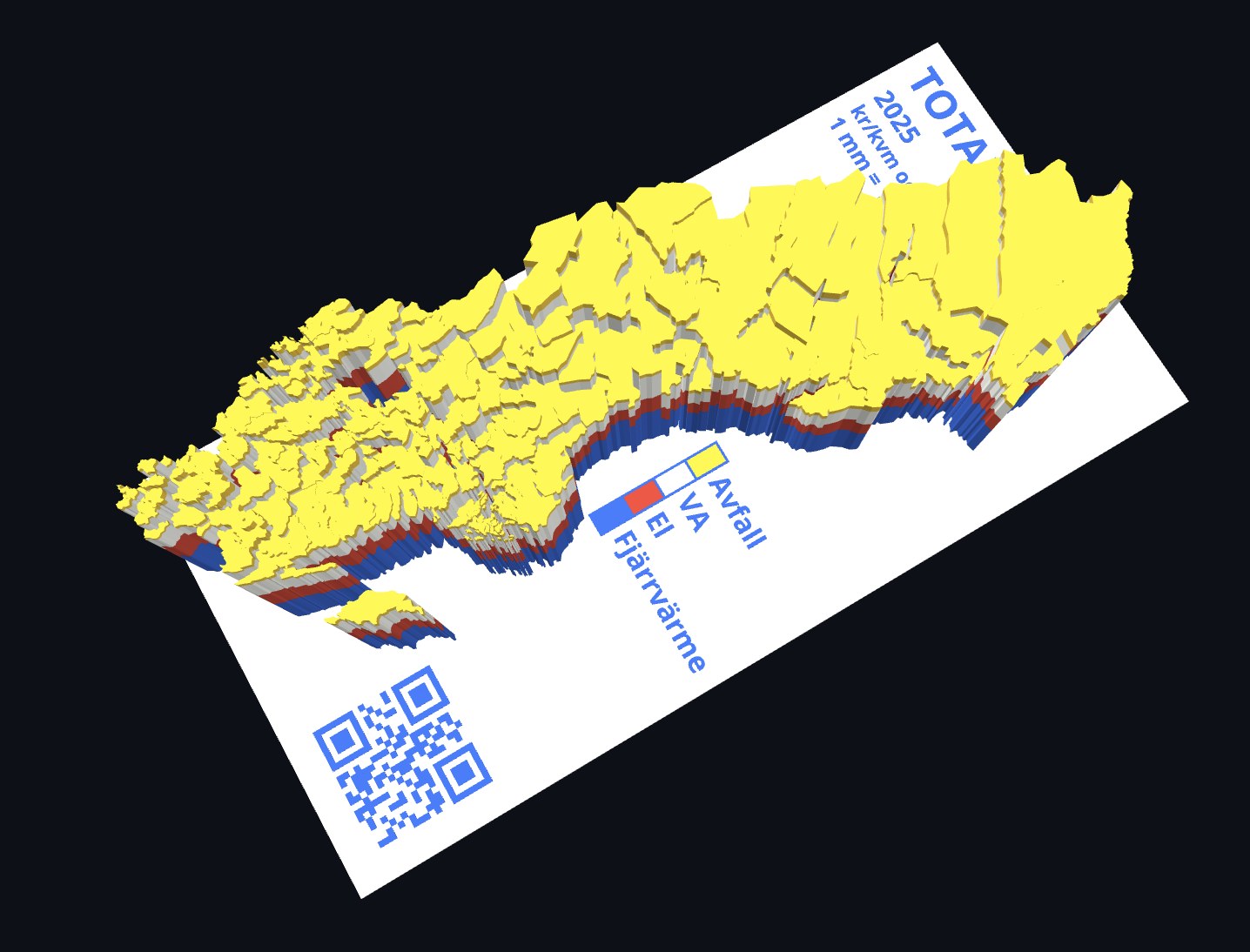
Thirty years of the Nils Holgersson reports as a printable map of Sweden: district heating, electricity, water and waste stacked as four coloured layers, at a fixed 1 mm per 10 kr/m².
Every year since 1996 the Nils Holgersson reports have compared what it costs to run the same typical apartment block (1,000 m², 15 flats) in every Swedish municipality: district heating, electricity, water and sewage, and waste. I have turned all thirty years into an interactive database with a 3D map, time series and rankings. This week the 3D map learned to print in colour.
One layer per cost
Each municipality becomes a column on a map of Sweden, and the column is built from four stacked layers, one per filament: district heating in blue at the bottom, then electricity in red, water in white and waste in yellow on top. The base plate is white with blue text. A legend east of Gävle shows the four layers with their names, each printed in its own colour.
A fixed scale
Height follows a fixed scale, 1 mm = 10 kr per m² and year, so two models printed separately can stand next to each other and still be compared. A district-heating-only model and a model of the total share the same height scale.
In the new 2026 report, the total ranges from 388 kr/m² in Piteå to 687 kr/m² in Gnesta, with a median of about 529. On the print that is a column of about 39 mm next to one of about 69 mm. District heating on its own ranges from about 142 kr/m² (Luleå) to 323 kr/m² (Älvdalen).
Over the whole period, the total cost for the typical block has risen about 168% since 1996, while consumer prices rose about 63%.
Small details
Each model carries one QR code linking to the matching view in the online database. I tested how small it could get: error-correction level L gives the smallest code (21×21 modules, under 1 mm each), and a raised height of just 0.2 mm on top of a 0.4 mm recess was enough to read it. Higher relief only made it harder to print.
Data: Nils Holgersson reports 1996–2026 (nilsholgersson.nu). Consumer prices: Statistics Sweden (KPI).
Comments? Reply on Bluesky @hedin.it.
Get new posts: Follow on Bluesky Follow on Facebook RSS feed How?