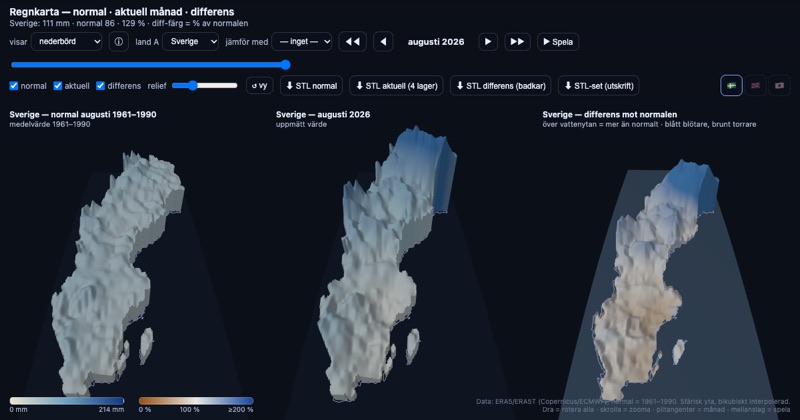
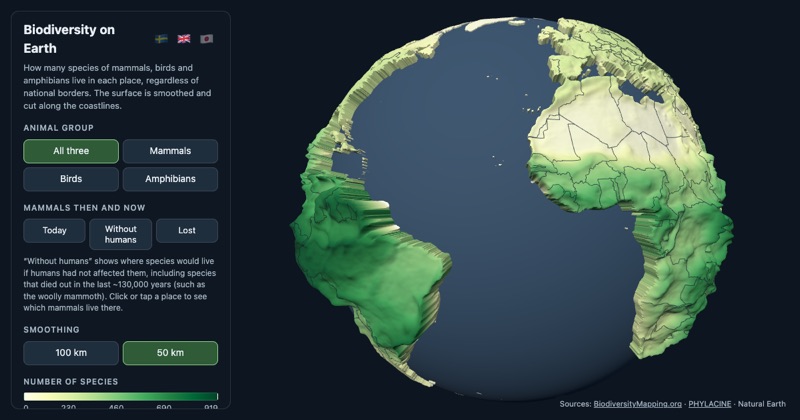
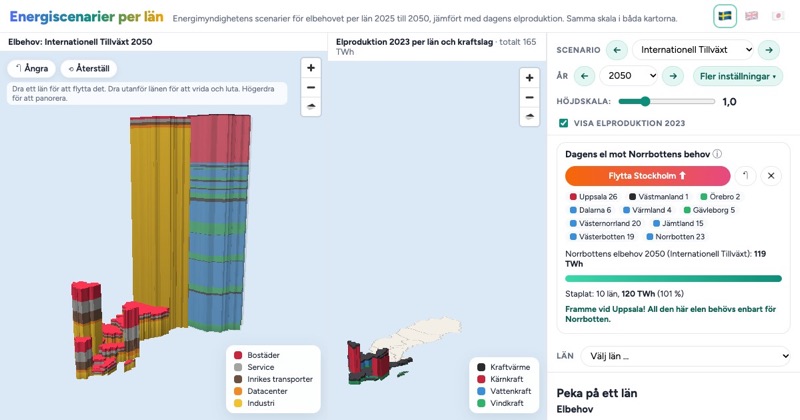
Arctic sea ice, any two years since 1979
Two globes side by side showing daily Arctic sea ice thickness from PIOMAS. Pick any two years from 1979 to 2025, play them day by day, and print the ice as a 3D puck.
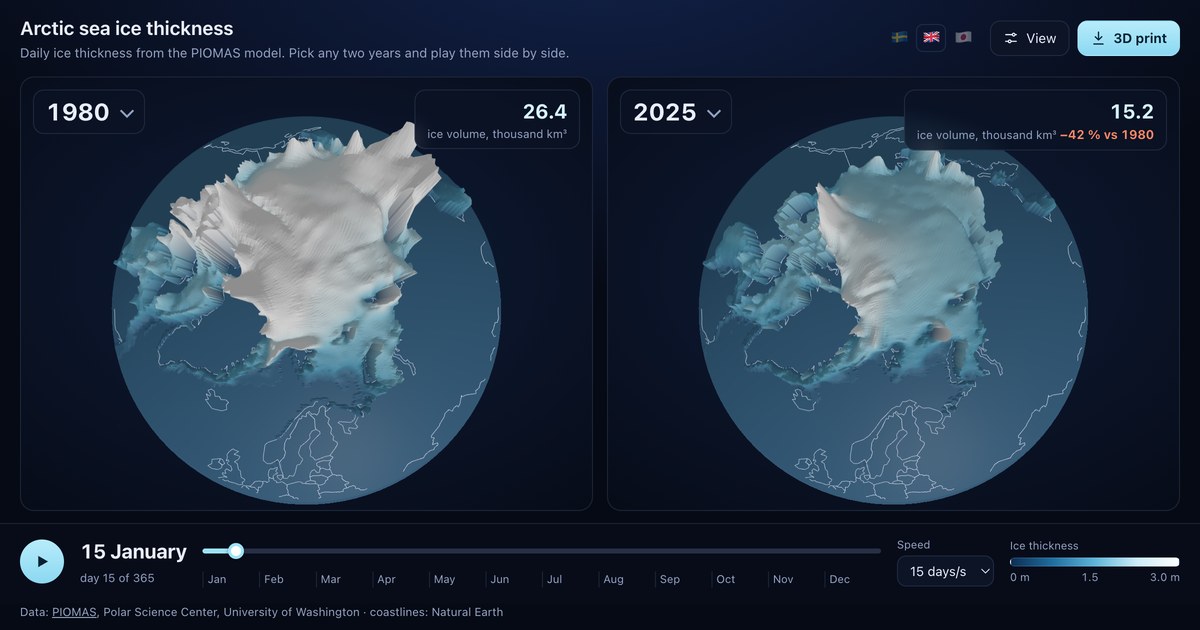
Sea ice extent gets the headlines, but thickness is where the real loss shows up. An Arctic covered by thin first-year ice can look similar to one covered by thick multi-year ice in a satellite photo, yet it holds far less ice.
The new version of Arctic sea ice thickness shows daily ice thickness from the PIOMAS reanalysis on two globes side by side. Until now it compared two fixed years. Now you can pick any two years from 1979 to 2025 and play them day by day. Each globe also shows the ice volume for that day, and the right globe shows how much it differs from the left. The comparison lives in the URL, so a specific pair of years can be shared as a link, for example 1980 vs 2025. On 15 January 1980 the Arctic held about 26,400 km³ of sea ice. On the same day in 2025 it held 15,200 km³, 42% less.
Making it fit in a browser
PIOMAS raw files are 17–21 MB per year, 850 MB in total. By storing thickness in 4 cm steps (at most 2 cm off, which is 0.06 mm in a print), keeping only cells that have ice, and storing each day as a difference from the day before, a year shrinks to just over 1 MB. The volume computed from the compact format agrees with the official PIOMAS daily volume to within half a percent.
Ice you can hold
Each globe can now be exported as a 3D-printable puck in four parts (ocean, ice, coastlines and a date label) so it can be printed in several colours. Two pucks from different decades next to each other on a table make a very different argument than two lines on a chart. Why that is, and when it isn't true, is a big part of what I study in data physicalization.
The page is available in English, Swedish and Japanese.
Get new posts: Follow on Bluesky Follow on Facebook RSS feed How?